THE TITLE TRAP / PROTECTION ORDERS & EVICTION
The dispute did not stay on the deed.
We were running Silver Creek while defending the place where it operated. A dispute over title, money and a failed purchase expanded into protection proceedings, police allegations and a request for possession of the care-home premises. Separate regulatory complaints added another burden.
Put the words beside the remedy. Earlier assurances concerned our livelihood. Later applications invoked anticipated removal proceedings. The possession complaint then asked a court to recover the premises. Those choices are documented. A hidden intention to destroy the business is a different claim.
Jun and Aileen held recorded title and bore mortgage obligations. We had signed leases, our 2025 purchase financing failed, and our messages included genuine hostile language. Those facts stay beside our account. Allegations, temporary orders, merits findings and settlement dismissals are different kinds of evidence.
JULY 18–20, 2025
A deadline for the house was a deadline over our livelihood.
In the preserved exchange, Romeo asked: What are you gonna do? Destroy our livelihood?! Do you understand the ramifications of what you’re doing here?
Aileen’s later reply questioned his ability to obtain financing and said not to blame her if his livelihood was destroyed. Her July 20 words, preserved inside Romeo’s reply email, again assigned responsibility for the effects on the AFH to us.
What the record shows
The same July 19 message beginsalso, dont blame me kng ma destroy ang livelihood nimu kay thats ur own doing..
Working translation: Also, don’t blame me if your livelihood is destroyed, because that is your own doing.
d na nako prob kng dka mka secure ug lender na mo approve nimu..—working translation: it is no longer my problem if you cannot secure a lender who will approve you—and ends
Aug 4, save the date. Romeo’s preceding message was accusatory; he described the business as being held hostage. That was his accusation, not a court finding.
What happened next
In a July 20 email demanding supporting purchase and loan documents, Romeo expressly demanded clarification of what would happen if closing did not occur by August 4: State your intentions.
The reply container attributes to Aileen: Dont blame us on the effects this will cause to your AFH
. It also preserves her stop-contact instruction with an exception for purchasing the house. Romeo replied See you in court.
The parties subsequently signed an extension to August 31; we did not complete the 2025 purchase on that schedule.
What this comparison establishes—and leaves unresolved: The language shows that financing and consequences for the business were expressly being discussed. It does not contain an authenticated promise to destroy the business. “Did not care” is not presented as a separate verified quotation. The earlier ownership acknowledgments and livelihood assurance deserve to be read beside this exchange and the later possession request, while retaining the failed financing, signed obligations and the Capinpins’ mortgage exposure.
Read the words, reciprocal replies and source limits
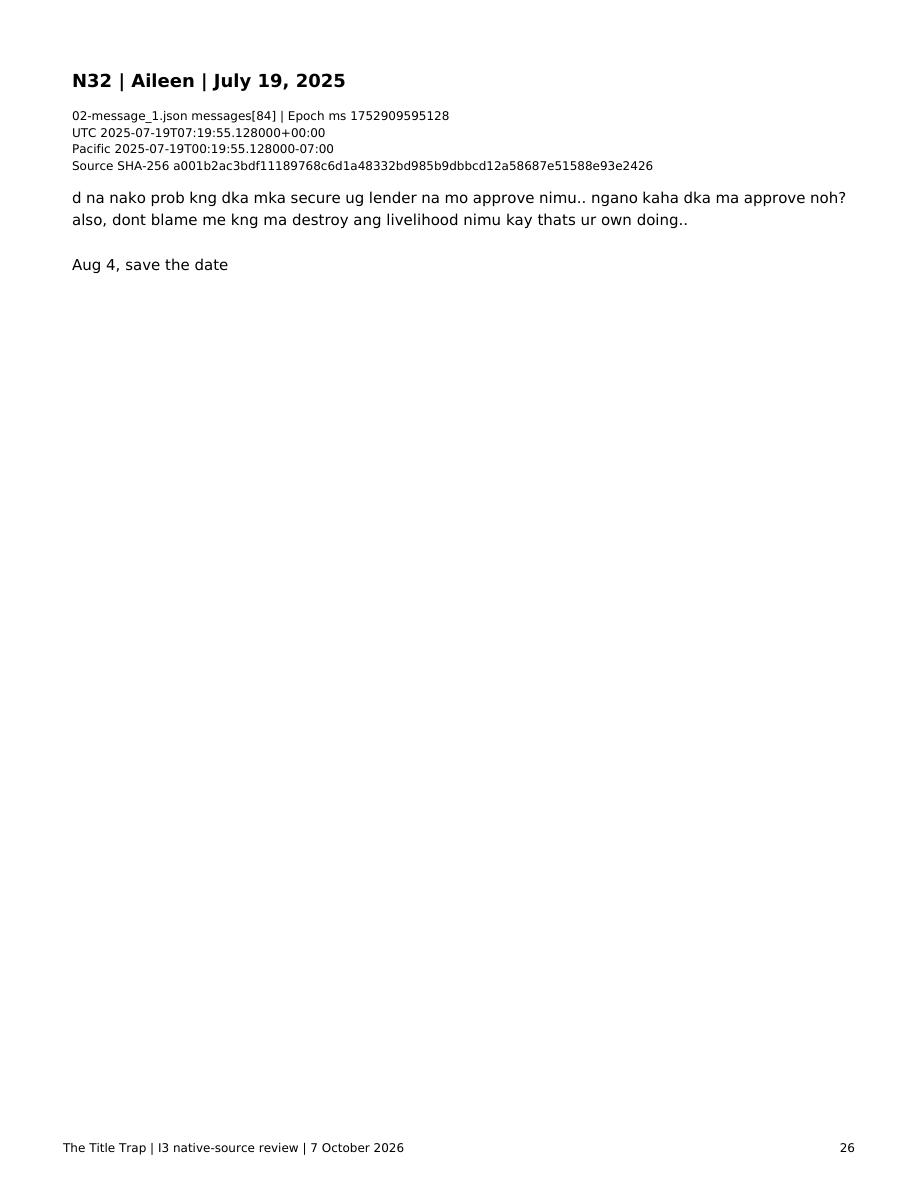
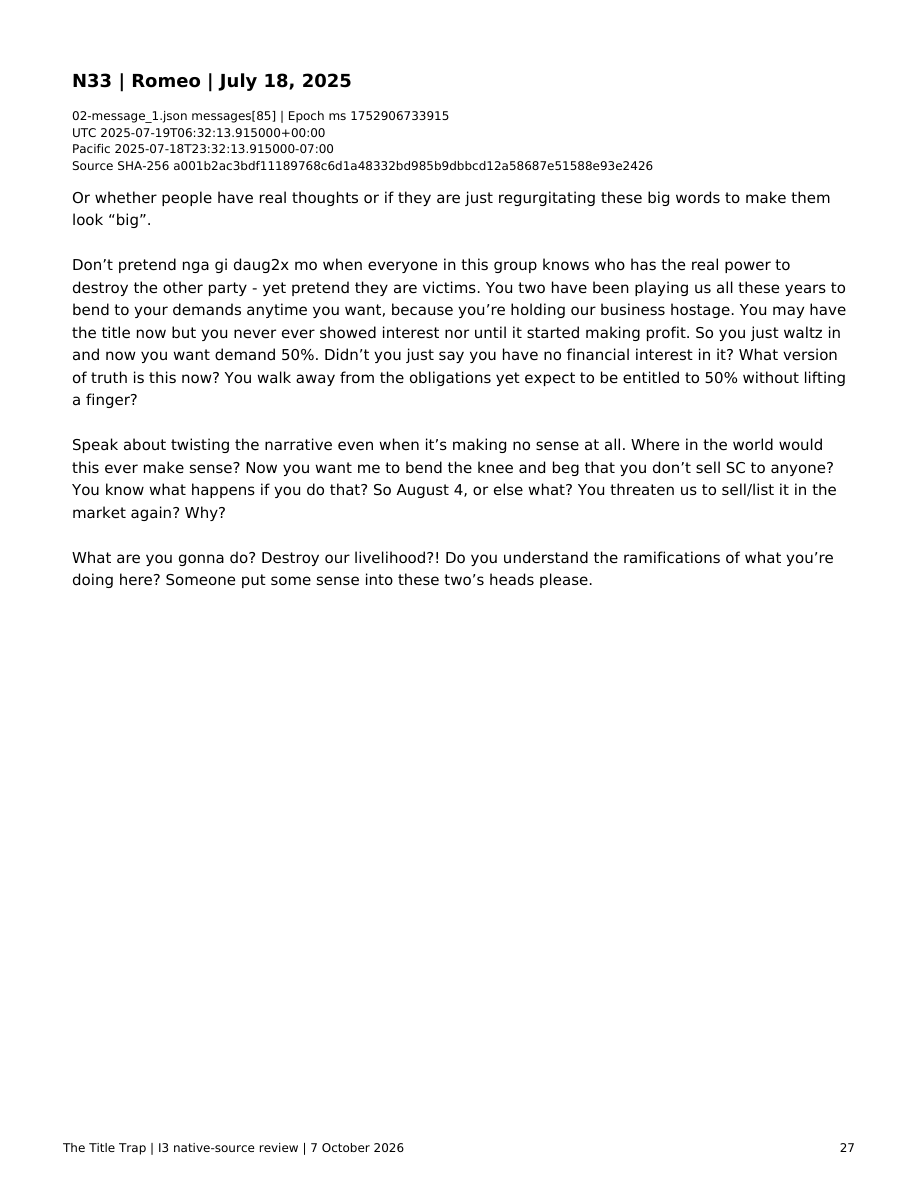
The derivative identifies the native container as 02-message_1.json, entries 84 and 85. The two source-text pages preserve the recorded timestamps and source hash. This run has not recovered that exact native container afresh. These pages are one source chain, not independent confirmations.
Open the exact approved E1-N PDF, pp. 26–27 · Open the exact approved July email selection, pp. 2–3
The July email selection is a derivative of recovered EML containers. The July 20 Aileen message is a quotation inside Romeo’s email; a separately authenticated sender-original email is not claimed. The quoted sent time supplies no explicit timezone. Working translations are identified as such.
July 19 source images and financing criticism · July 20 quoted-email source images · Earlier livelihood assurance and its qualification
Jun’s August 4 boundary changed to a signed August 31 extension. Their separate purchase later recorded August 27. Changed funding or lender conditions could explain the dependency statement; recording alone does not prove it was knowingly false. Read the alternatives and extensions in context.
Source trail: Approved E1-N N32–N33, PDF pp. 26–27; native locators recorded there. Approved I3-E pp. 2–3. Existing VS12–VS14. I4-D extension selection; investigation §5. Compare the requested possession remedy.
JULY 21–AUGUST 5, 2025
The July case ended at Jun’s request. It was not the November merits decision.
Jun’s July petition described continuing harassment and used Romeo’s genuine I will destroy you
language in its immediate-protection explanation. It also described harassment since approximately October 2024. The older quotation and the newer July messages must both remain in the account.
What the record shows
The petition’s signature/submission page says July 21; its first-page e-file stamp says July 22 at 8:30 a.m. The District Court docket records submission and payment July 22, processing July 23, and a corrected filing date of July 22. These are distinct events, not competing dates to silently replace. On July 24 the court denied temporary relief without notice and scheduled a full hearing. The checked temporary-denial reason was insufficient basis for relief without notice; an unused printed option is not a finding.
What happened next
At 3:36 p.m. July 24, Jun emailed a cancellation request, stating that after consulting counsel he believed proceeding could complicate matters further. The hearing was initially set August 7, then rescheduled August 5. The docket says the service packets had not been collected July 31. On August 5 it records Romeo as not served, Jun absent, and the case ending at the petitioner’s request.
What this comparison establishes—and leaves unresolved: Withdrawal and lack of service describe the procedural outcome; they do not prove every July allegation false. The October 1, 2024 date belongs beside the hostile quotation. It challenges a compressed presentation of that message as current, not the existence of the words or an entire exhibit containing newer messages.
Keep the July petition, docket and cancellation separate
July case: 5A650856A, an antiharassment proceeding. Original petition p. 1 contains the filing stamp; p. 6 contains the immediate-protection explanation; p. 8 carries the July 21 website-submission date. District Court docket pp. 1–3 carries the processing, hearing and service sequence. The July 24 cancellation request is a party’s request, not counsel’s confidential advice.
The October 2024 source exchange concerns equity, investment and livelihood and contains Romeo’s profanity. July messages were also submitted. This chapter does not describe the whole exhibit as old or fabricated. The October temporary orders and November 4 merits outcomes follow under different cause numbers.
Read the existing July source comparison · Continue to the separate November decision
Source trail: Original July petition pp. 1, 6, 8; District Court docket 5A650856A pp. 1–3; July 24 cancellation email; existing R1 E51–E54 source comparison. These originals were inspected privately; no unredacted original is linked here.
OCTOBER 20–21, 2025
The connection to removal is written into the emergency applications.
The October 20 demand asserted $22,605.28 under the lease and threatened removal and collection if its claimed default remained uncured. This is the Capinpins’ asserted balance and remedy position, not an adjudicated debt.
What the record shows
The next day’s petitions expressly referred to anticipated default and removal proceedings in explaining feared retaliation. Annie’s petition, original p. 7, says that legal proceedings for removal would follow if the respondents failed to comply. Romeo’s petition, original p. 8, similarly links the pending default action to feared retaliation. This connection comes from the applications themselves. Both inspected petition first pages check Domestic Violence under chapter 7.105 RCW; the July case was antiharassment.
What happened next
Temporary protection orders were entered October 21. The applications requested personal restrictions; their requests were not all granted. The November 4 full-order requests were later denied on the merits and dismissed. The lease balance and ownership dispute were not resolved by those protection rulings.
What this comparison establishes—and leaves unresolved: The property confrontation formed part of the applicants’ asserted emergency. We interpret that as an expansion of pressure around the care home. It does not prove that subjective fear was invented, that an evaluation request was a diagnosis, or that counsel directed a false filing.
Compare the requests with the orders actually entered
| Case | Petition selections | Verified temporary-order record |
|---|---|---|
| Romeo 25-2-03906-0 | Domestic Violence; no harm, no contact, stay-away and stalking restrictions; mental-health evaluation; abusive-litigation restriction; weapons surrender and immediate surrender. Current firearm ownership and immediate firearm danger marked unknown; past weapon use against petitioners marked no. | Domestic Violence cover; no-harm, no-contact, stay-away and stalking restrictions appear in the inspected order pages. Cover marks no weapons surrender and no firearm-possession prohibition. A requested evaluation is not shown here as an entered diagnosis or finding. |
| Annie 25-2-03908-6 | Domestic Violence; no harm, no contact, stay-away and stalking restrictions; mental-health evaluation; immediate protection. Weapons-surrender request unchecked; immediate-weapons Yes/No both unmarked. Abusive-litigation restriction unchecked. | The sheriff’s service confirmation records a temporary order in this separate case. This run has not recovered its complete original temporary-order packet afresh; do not assume every petition request was ordered. |
Romeo petition filed 11:03 a.m.; Annie petition filed 11:34 a.m., October 21. The petition form and temporary order are separate records. The completed confidential law-enforcement information form and its contents are excluded.
Open the previously reviewed one-page Annie default/removal excerpt · Read the disputed balance beside the lease, no-default recital and conditional payments
Source trail: October 20 demand; Romeo filed packet, petition pp. 1, 3–8 (physical PDF pp. 15, 17–22), temporary order pp. 1, 3–4; Annie petition pp. 1, 3–7; reviewed default excerpt. Checkbox selections visually inspected.
OCTOBER 23–24, 2025
A party-filed accusation preceded documented physical service by three minutes.
The October 24 filing titled POLICE REPORT STATEMENT
concerned information relayed from an October 23 exchange involving Cora. Jun and Aileen requested investigation of alleged indirect contact. The title did not make it an officer-authored finding.
What the record shows
The party statement’s filing stamp is 12:27 p.m. The preserved service return records 12:30 p.m. This first statement is separate from the alleged 1:30 p.m. family-chat conduct later described in the October 27 sheriff report. An underlying exchange, another person’s relay, the petitioners’ filed characterization and an officer’s report must not be counted as multiple independent confirmations of the same allegation.
What happened next
The temporary orders had already been entered October 21. A separate October 27 agency narrative confirmed recorded October 24 service and documented the later family-chat allegation. This chapter keeps those two reporting episodes apart.
What this comparison establishes—and leaves unresolved: The filing preceded the documented physical service time by three minutes. It does not establish that there was no earlier actual notice, when any police call occurred, whether all timestamps capture the same event, or whether a violation legally could occur.
See the filing stamp and service record beside each other
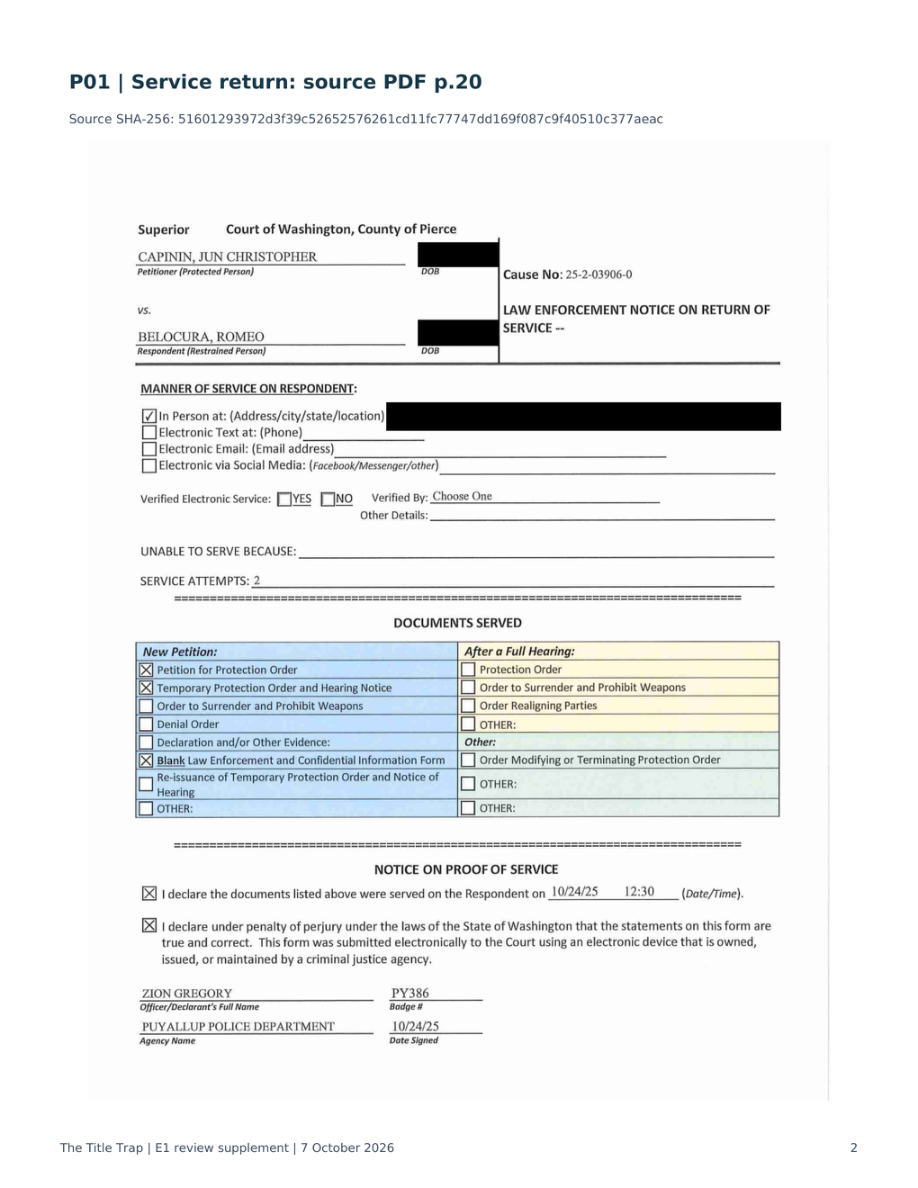
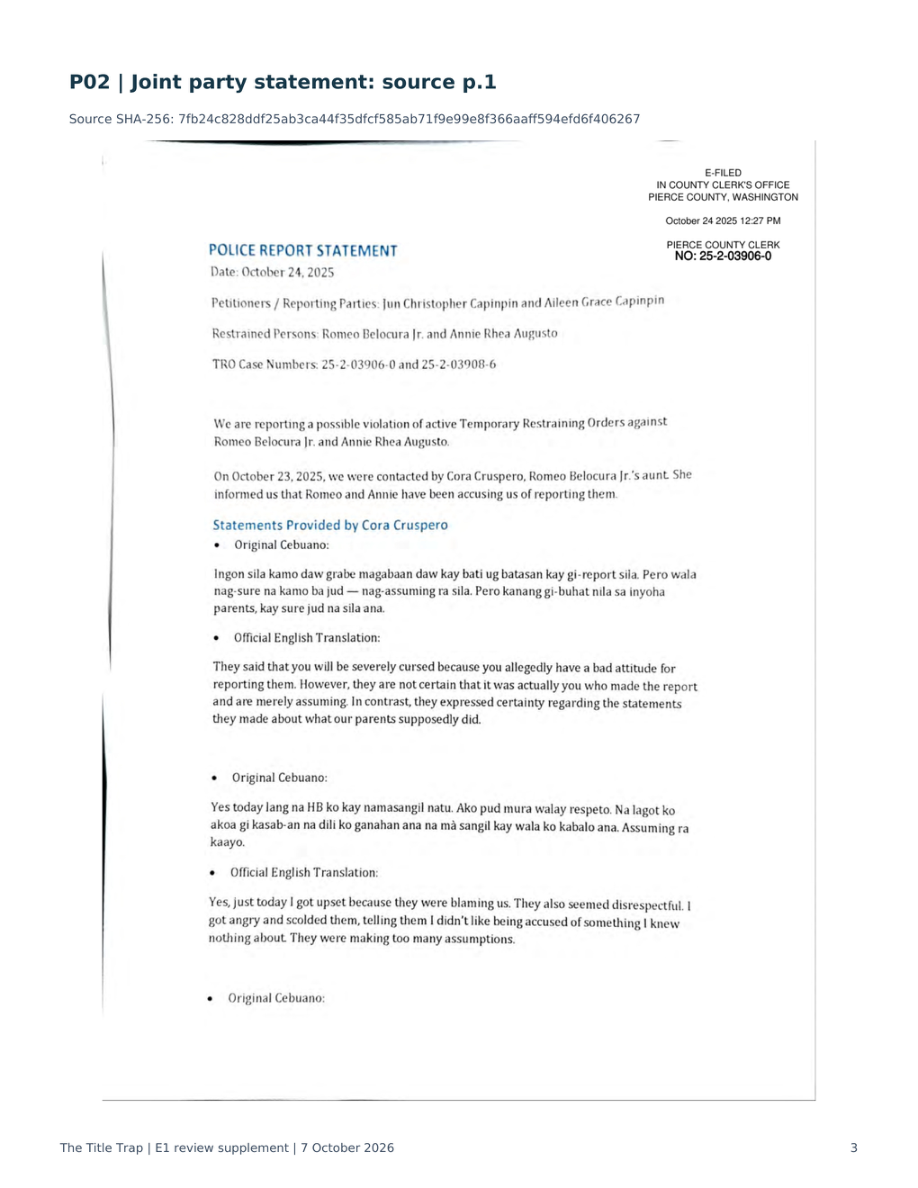
The displayed records are selected pages from the approved I7 reporting selection, not the completed confidential law-enforcement information form. The complete underlying October 23 communication and relay remain necessary for a comprehensive contact analysis.
Source trail: Approved E1-P P01–P04, selection pp. 2–5; corresponding service source physical p. 20 and party statement pp. 1–3. PCSD 2530000948.1 narrative printed p. 5 corroborates service, not the earlier exchange’s entire history.
OCTOBER 27–NOVEMBER 4, 2025
The messages existed. Their route, meaning and speakers still required scrutiny.
Deputy Carter Harmes’s report records Jun saying he had left the Facebook family group when seeking protection and accidentally saw its messages on his father-in-law’s iPad. The officer advised him to leave the chat on his devices and avoid the iPad or its chat. The deputy received three screenshots.
What the record shows
The agency report is an officer’s record of the allegation and investigative steps, not a conviction. Its supplied disposition is active, not a final criminal outcome. Jun’s later declaration alleged that the messages were intended to reach the Capinpins. Romeo’s hostile “digging their own graves” language and Annie’s medication language were real; context and attribution remain material.
What happened next
Jun’s October 30 declaration combined medication and restraints language under Annie’s name, although the attached images display separate speakers. His November 4 correction attributed the restraints remark to another participant. The medication attribution remained. Separately, the sheriff narrative attributes So you want to take this fight to this level? I accept
to Annie, while the later declaration attributes it to Romeo. The source-attribution mismatch is unresolved.
What this comparison establishes—and leaves unresolved: The corrected restraints attribution is a documented error and correction, not proof of knowing falsity. The iPad account establishes a reported access route, not hacking or unlawful access. The travel evidence does not make an undated device account impossible. We challenge the presentation and inference without pretending the unfavorable words were imaginary.
Compare the access accounts, travel lead and speaker record
| Source / date | Exact account | Corroboration | Discrepancy or unresolved question |
|---|---|---|---|
| Deputy Harmes narrative October 27, 2025 Printed p. 5 | Jun stated that his father in law came to stay with them and had left his Ipad at there house.The next sentences report return to the Philippines and accidental viewing of the group messages. | The officer independently records the account and receipt of three screenshots; the device route itself is Jun’s report. | No visit or device-transfer date is supplied. The narrative does not identify when or by which route the device reached that house. |
| Jun declaration October 30, 2025 p. 2, ¶¶2–3 | Describes messages directed toward us, and that were meant to be communicated to us; says his father-in-law was in the family group. | Attached screenshots support that messages existed. The full native October thread was not recovered in this run. | Access route and intended relay are different propositions. Screenshots alone do not decide who intended a later relay. |
| Supplied travel-history image Retrieved September 11, 2026 | Latest displayed departure: November 26, 2020; preceding displayed arrival: April 22, 2019. | Consistent with Romeo’s report of a last US stay ending in 2020, subject to identity and travel-record completeness checks. | No date in the sheriff’s account directly conflicts with these entries. This image does not establish where the iPad was or rule out another transfer route. |
| Romeo’s reported relative denial Date not established | Romeo reports that the relative denied leaving an iPad at the Uplands house. | No dated, directly attributable denial was recovered in this run. | Obtain the relative’s own account and device provenance. Delivery through another person or route remains unresolved. |
Public identification is by family role. The travel original, document number, private residence and unrelated family identities are not reproduced.
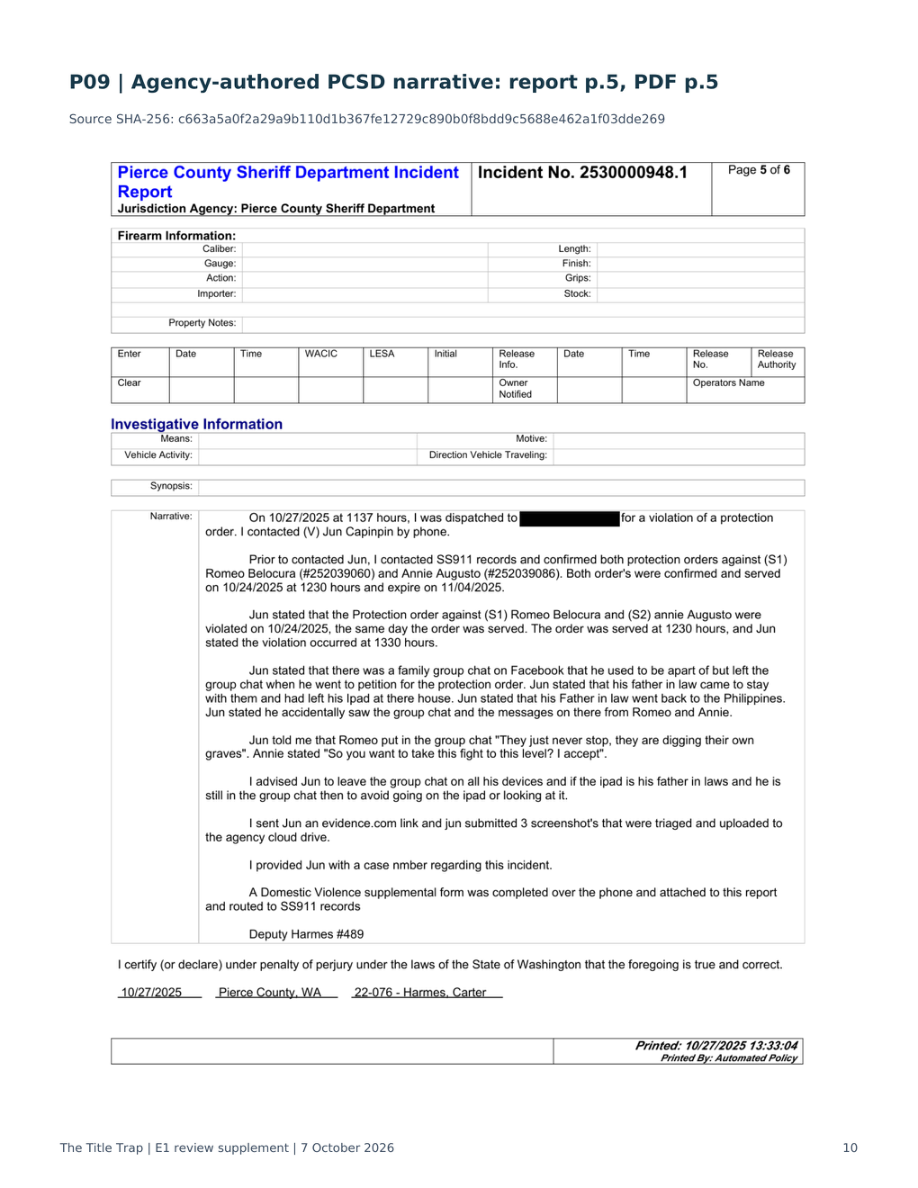
The complete native October thread, device history and final criminal disposition remain unverified. The underlying language and the petitioners’ interpretation of it are distinct.
Source trail: Actual PCSD report 2530000948.1, printed pp. 1, 4–5; approved E1-P P09, PDF p. 10; Jun October 30 declaration p. 2 and submitted speaker screenshots; November 4 correction as preserved in current source comparison; supplied travel-history image, privately inspected.
NOVEMBER 4, 2025
The full protection requests failed on the merits. The contact warning remains.
The October applications asserted an emergency. At the November 4 hearing, the court considered the protection requests under the two separate cause numbers. Both signed final forms select denial on the merits after a hearing and dismissal. This was different from the July temporary-relief denial and petitioner-requested termination.
What the record shows
The separately preserved written addendum says the dispute concerned property and a contract, finds no active threat of violence and no sufficient pattern of unlawful conduct for the protection requested, and credits the contextual explanation of the “9-11” remark. It also explains that a family birthday appearance involving a child drop-off was not necessarily harassment. These are bounded findings on the presented record.
What happened next
The addendum warns that the Capinpins wanted no further contact other than through attorneys and that further unwanted contact or lashing out could support an order. The court did not endorse our angry communication. The form’s boxes for abusive litigation and an entirely meritless temporary order are not checked.
What this comparison establishes—and leaves unresolved: The court rejected continuing protection after hearing the cases. It did not find that every allegation was fabricated or decide the lease debt, ownership percentages or all subjective fear claims. The addendum’s printed heading repeats 25-2-03906-0; the separate signed order for Annie uses 25-2-03908-6. That repeated heading remains a source discrepancy, not a number silently corrected by this publication.
Read the written finding, its warning and its provenance
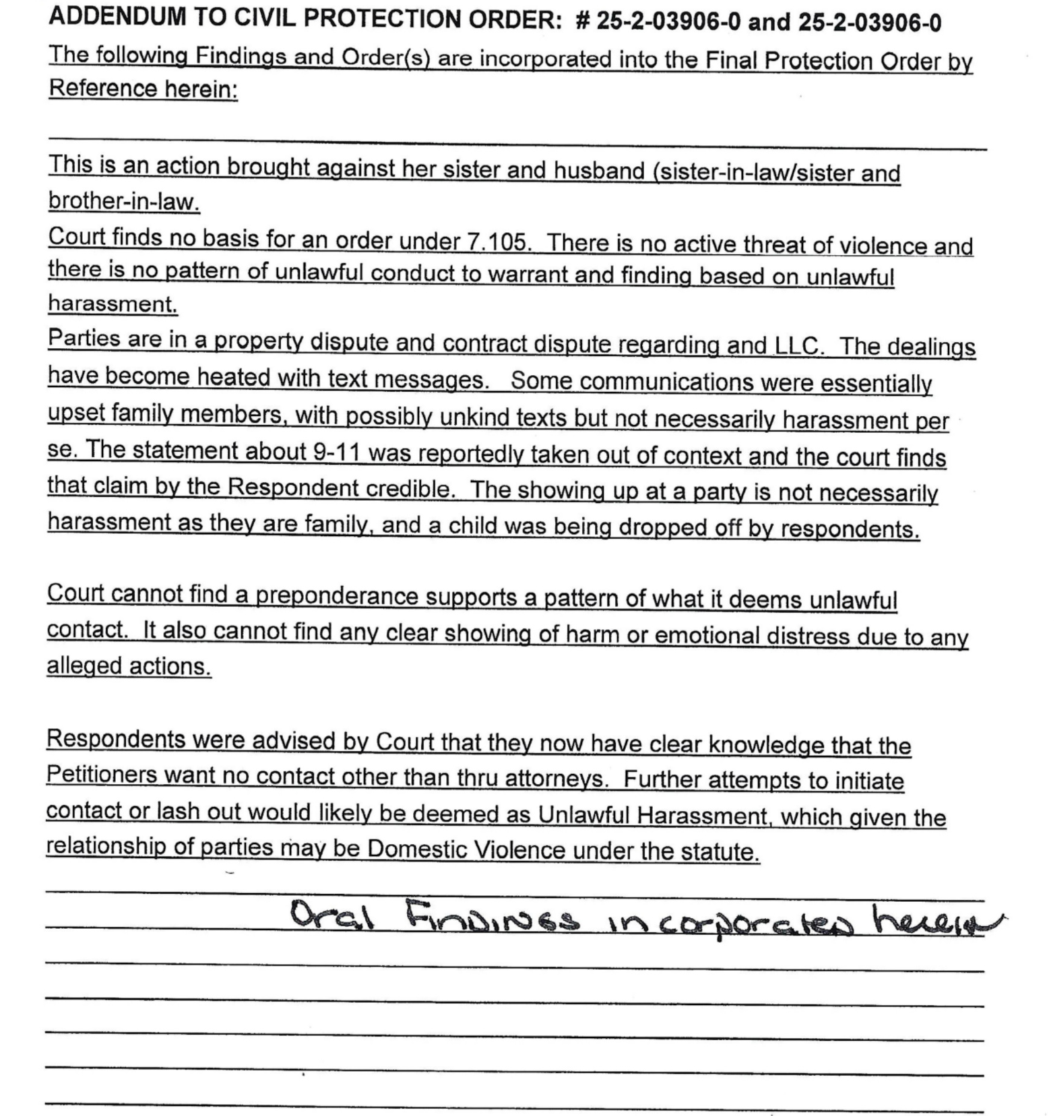
Inspected approved I7 complete order selections: cover p. 1; original denial form p. 6 at physical PDF p. 7; signature/order date at physical p. 10; supplied addendum at physical p. 11. The individual denial forms were checked separately. Both supplied addenda repeat the same heading; a fresh certified association remains outstanding.
Exact reviewed M2, E12 at PDF p. 15 · Romeo order source notes · Annie order source notes
The hearing audio and machine transcript have not been authenticated or aligned. No oral quotation is used here.
Source trail: Approved S1-Romeo and S1-Annie complete redacted selections, physical pp. 7, 10–11; E12; separate hearing minutes RR05/RR06. Findings association remains qualified. No certified or audio-verified transcript is claimed.
NOVEMBER 24, 2025–JULY 2026
They asked for the premises—not merely an accounting.
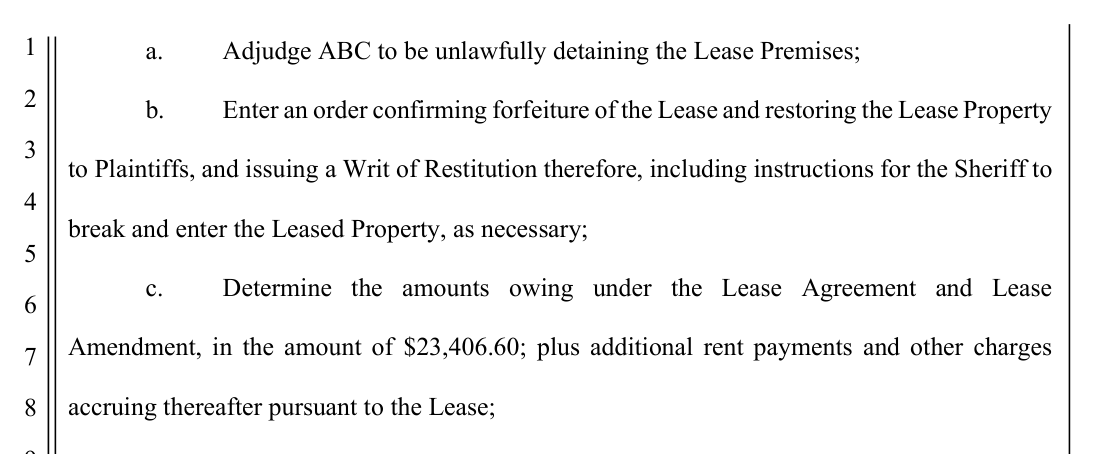
The November 24 unlawful-detainer complaint alleged unpaid lease sums and requested lease forfeiture, restoration of possession and a writ of restitution, including sheriff-entry instructions if necessary. The pleaded debt and entitlement to those remedies remained claims.
What the record shows
The commercial lease identified adult family home use. A possession remedy, if granted and enforced, would have threatened ABC Elder Care’s continued use of that operating location. Keeping a company’s shares while losing its premises would not preserve the same livelihood. Residents’ continuity of housing and care were practical stakes, although they were not parties to the title dispute.
What happened next
Our ownership complaint was prepared December 26 and filed December 29, 2025, in case 25-2-14126-3. It asserted equitable ownership and related claims; it was not a judgment awarding us title. The later lis pendens, recorded release, settlement dismissals and July 23, 2026 recorded deed mark separate procedural and conveyance events. The purchase secured the home through negotiated resolution. No executed writ or resident eviction is established here.
The entered orders now supply the terms behind the docket entries: the ownership action was dismissed with prejudice on February 3, 2026, and the eviction action on February 4. Both followed the parties’ settlement stipulations. Neither order determines whether either side’s underlying factual allegations were true or false.
Open ownership dismissal order — 3 pages · Open eviction dismissal order — 3 pages
What this comparison establishes—and leaves unresolved: The requested possession remedy supplies the direct business connection without speculation about hidden motive. The settlement dismissals were not merits victories in the property cases. Earlier ownership language and livelihood assurances can be critically compared with requested possession while recognizing the signed lease and financing failures.
Read the exact complaint and keep the posting claim separate
Open the exact reviewed six-page possession packet: cover p. 1; filed pages pp. 2–6; claimed sums pp. 4–5; prayer/writ p. 6 (original complaint p. 5).
Door and window notices: Romeo and Annie report arrears notices posted over three consecutive days and describe the pressure on an operating home. This run did not recover dated posting photographs, exact notice copies or independent visibility evidence sufficient to establish that sequence. It is retained as their report, not a corroborated three-day chronology or a conclusion that each posting was unlawful. Dates, locations, who could see the postings and specific operational effects remain open.
Ownership pleading and corrected filing date · Lis-pendens release · Recorded deed excerpt · Full resolution timeline
Source trail: RR01 exact reviewed packet, physical pp. 4–6; RR03 permitted-use clause, original p. 1; ownership receipt/docket and preserved pleading notes; RR33 recorded release; E14 deed. Posting sequence remains attributed and uncorroborated.
SEPTEMBER 2025–MARCH 2026 / A SEPARATE TRACK
The allegations were serious. Their recorded outcomes belong beside them.
Separate regulatory matters required responses while the home kept operating. These processes must not be collapsed into a single complaint or attributed to Jun or Aileen from timing alone.
What the record shows
The RCS Investigation Summary, Intake 194932 / CD65963, records investigation on September 30, 2025, a sample of all six residents, no citation and no facility failed practice in the reviewed areas. It expressly limits its labor authority and says 2021 resident records were not available under the three-year retention window. The current chronology separately identifies a November 5 DSHS nursing referral, Intake 200859. That timing follows the merits hearing; timing is not authorship evidence.
What happened next
Annie’s WABON case 2025-17807RN was closed without investigation at threshold screening; no nursing violation was identified. The assessment worksheet is dated November 18, 2025. A March 17, 2026 assessment after additional DSHS information marks “Remain Closed,” and the closure communication carries that March 17 date. Those dates identify assessment and later confirmation, not the original complaint submission.
What this comparison establishes—and leaves unresolved: The agency outcomes answer the allegations within their actual scope. They do not establish universal exoneration, malicious reporting, common complainant identity or retaliation. The September 17 date remains a claimed intake-date lead requiring its original intake record; the public investigation date is September 30. The November referral is kept separate from the September investigation.
Read the scope of each agency outcome
RCS: agency-findings packet EX-0018, physical PDF pp. 3–4. WABON: EX-0020, physical pp. 6–7. The WABON worksheet and closure letter were visually inspected. No resident records, confidential intake, reporter identifiers or protected health details are reproduced here.
The November 5 referral date comes from the established source trail; the original referral has not been independently verified. No common complainant has been established.
Existing agency comparison and limitations · Agency source index and scope
Source trail: Actual public-redacted agency packet EX-0018 pp. 3–4 and EX-0020 pp. 6–7; existing site’s Intake 200859 referral trail. September 17 intake and original referral require further source verification. Anonymous authorship is unresolved.
THE COMPARISON THAT MATTERS
Our criticism is about the choices the documents show.
Business consequences were expressly discussed. The default dispute entered the emergency applications. Possession of the operating premises was later requested. We had to answer those proceedings while continuing care and asserting our ownership position.
The records do not supply a verdict that everyone lied or that every later act had one motive. They supply a sharper question: how do the earlier ownership language and livelihood assurances stand beside the later demands and remedies?
Read the approved selections
Exact reviewed M2 Selected Evidence Book · Exact reviewed M3 Visual Reader · Approved I7 July email selection · Approved I7 native-message excerpt selection
These are selected and privacy-treated records, with original source boundaries retained. Public-reader editions update obsolete publisher status labels while retaining the reviewed evidence and redactions. They are not the confidential originals or the unreconciled RC4 source derivatives.
Open corrected protection comparison · Open settlement operative pages. Selected records retain the qualifications described in the source index; the settlement is not a merits verdict.
Read the proceedings and outcomes: Romeo’s complete denial · Annie’s complete denial · Romeo’s hearing minutes · Annie’s hearing minutes · RCS outcome · Nursing-board closure. The RCS report does not determine labor-law compliance; the nursing-board record documents screening closure.